
Procrastination is a Tutorial Level
Elite-level grinding on emotional skills

One time, for nine days I did not answer one VERY FUCKING IMPORTANT email. It was from an important fancy person.
It was not even a big deal you guys. The response was really like two sentences long. I knew this because I’d re-composed it about 30 goddamn times in my head while brushing my teeth, in the shower, lying awake.
It should have taken forty seconds.
Instead I recalibrated my supplement routine with the latest research, delivered on a silver platter by the weakly-godlike AIs in my employ (at the expense of a small pond in middle-America probably), and doomscrolled Alex Hormozi’s instagram where he tells people “just do the obvious thing, bro”.
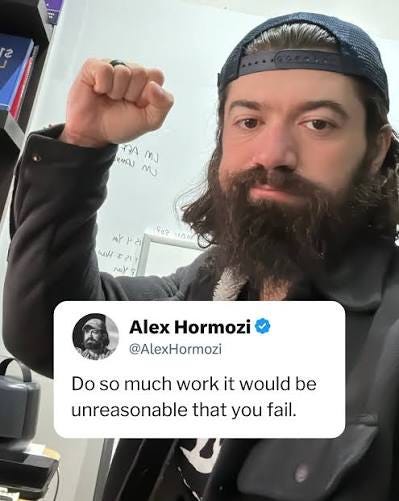
Clearly, I’m a glutton for punishment.
Obviously, the task was easy. With this kind of thing, the task is almost always easy. Hard tasks at least have the decency to be interesting most of the time.
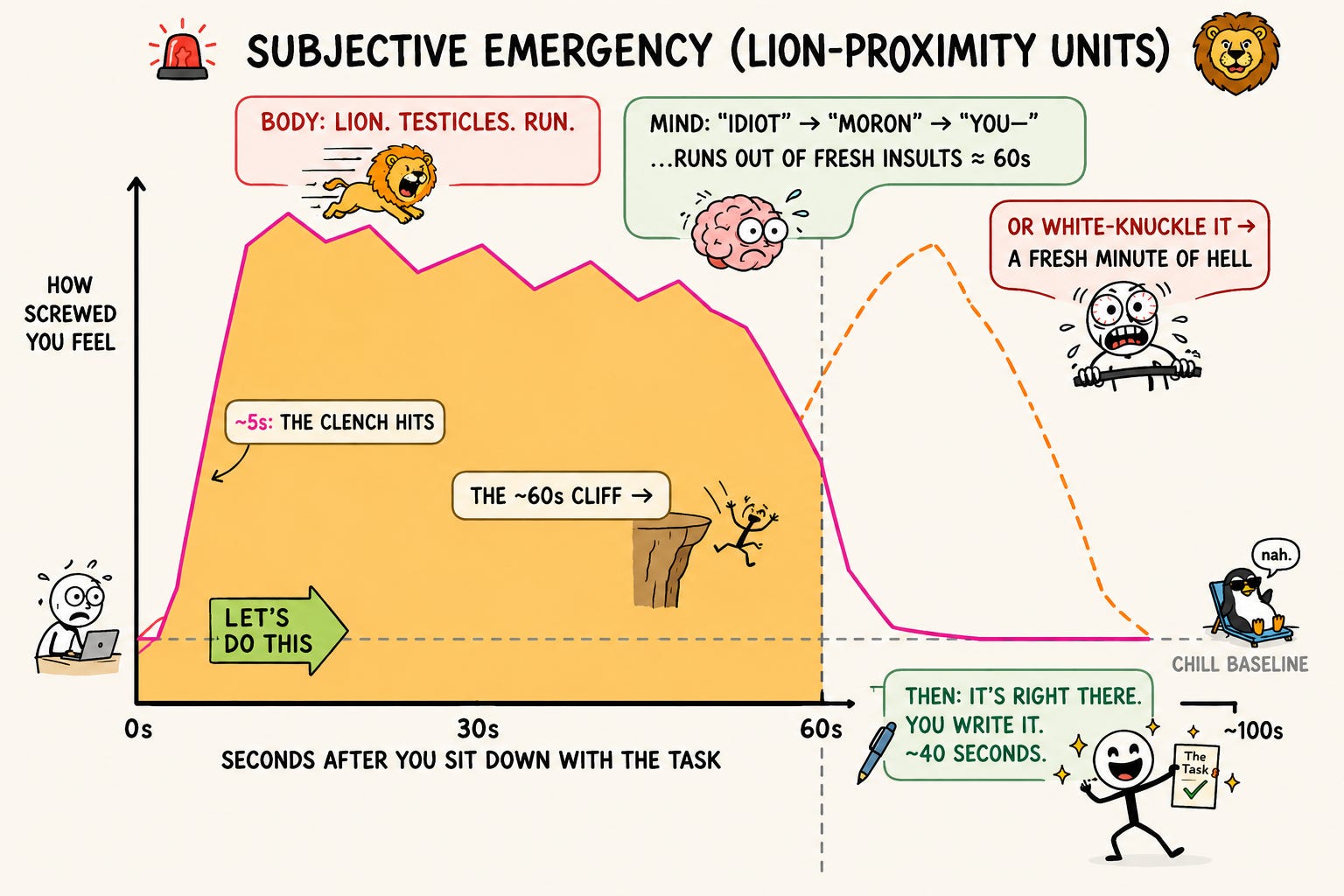
The unbearable thing about “The Task” turns out to be a ~60 second window.
In that window: concentrated, transcendental, time-dilated, needle-and-hammers pain-and-suffering that kicks in right when you start.
More importantly, I realized I could deliberately train my response to this feeling to make it more bearable.
Avoidance with more steps
The SCIENCE has countless solutions for the delicious addiction to avoidance.
Procrastination is just not that hard to deal with in the abstract. That’s why there’s a billion one-off methods for dealing with it. Cold shower / workout before doing something hard, five minute timer, etc.
I have tried most of these random hacks and they sort of work.
But after trying all the normal tactics, I noticed they were all basically the same move. Every single trick is a way to get past the feeling without feeling it.
Start so fast the clenching can’t catch you
Manufacture enough momentum to skip the moment entirely
Print some “dopamine” so you can push through the pain
This avoiding-avoidance half-works, which is a problem, because every time you sprint past the feeling you re-affirm to your body/mind/system again: the feeling is an emergency.
This doesn’t lead to kung-fu levels of discipline, because it’s just practicing avoidance with more steps.
You can just feel things
So one fine day, I tried the opposite. I sat down in front of the thing I was avoiding and I did not start it and I did not flee.
I just felt that shit. It sucked ass:
Mind: You fucking pathetic idiot how could you already be SO late on this stupid email it’s such an easy task goddamnit this person already thinks I’m terrible there’s nothing I could do to salvage this I could apologize but the damage is done fuck me why do I ALWAYS do this… etc. etc.
Body: Holy shit there is a lion about to bite off my testicles, RUN, why are you just sitting there staring at a screen we are literally going to die… etc. etc.
I did this enough to notice there’s a pattern to the madness. For me, after about 60 seconds in most cases, the flood of bad feelings drops off sharply. The mind runs out of fresh ways to rephrase: “you are a piece of shit.” The heart rate peaks and then comes back down.
There’s no breakthrough moment. The freak-out just gets quieter, and the email’s right there, and you write it, and it takes forty seconds.
another small pond consumed for a mediocre meme
IME The body’s on a roughly sixty-second clock and its freakout curve is reliable. The mind’s story is the big enemy here: get through the worst of it, feel a little relief, then try to force the thing done by white-knuckling through it and you just spin up a new fresh minute of terror.
So the key is not to argue with the story, don’t lawyer it, don’t fact-check your own self-slander.
Let the rant play out into the void and put your attention on the actual feeling in your actual chest. It’s temperature, pressure, and tightness. Wait out the explosion, let the body settle, and then slide into the thing. But like, in a chill way.
You’ll notice it’s way less painful once you peel the EMERGENCY sticker off it.
Procrastination is a tutorial
This is an example of a general-purpose emotional skill.
There are many tools like this, and a bunch of them work, and they work for more than just battling procrastination.
The specific tool matters less than learning to skillfully navigate and de-fuse emotional landmines, in specific situations that allow you to more effectively pursue your goals.
A small freak-out is real information, just poorly calibrated and aimed.
Typically, out-of-distribution reactions to simple situations are referencing something older and more load-bearing in the personality structure. There’s some belief you installed a long time ago about what happens when you get something wrong, who’s watching, what it all means. Blah Blah Blah.
So the email is sitting on a landmine. You step on it, the old thing fires, and your mind/body hands you a threat signal calibrated for a danger that’s decades expired.
Example: I sometimes freak out over emails because there is some early-childhood conviction that if a person with power over me is disappointed, something terrible and permanent happens.
Chase belief-chains like this long enough and you get to some version of “I’ll die, I’ll be alone forever, etc.” That seems extreme because the architecture of deep emotional beliefs is very often extreme.
But like, with a lower-case t
But, this response was trained in, so you can train it out.
So the deeper project is not to figure out how to answer emails faster. The higher leverage move is to find these buried landmines and start defusing them one at a time.
Procrastination is a great training ground, because the task is small, the stakes are low, and it fires on a tidy sixty-second timer you can practice with.
It’s a tutorial level.
Train the good things
This is worth grinding like a real skill and not just reading as a fun fact.
Every time you bypass a landmine, you teach your system with one more rep that the feeling is lethal and avoidance is correct. You are getting measurably, anime-montage-level better at being a coward.
Remember: you are always training something.
So train the good thing. Every rep is a chance to teach the system the scary thing is not quite as scary as it seems.
This is the unsexy part of becoming “high agency”. It’s just reps of a billion little emotional skills like this you don’t already have.
Good news and bad news
Good news: Doing reps on one challenging thing will leak into other challenging things.
You can defuse the email landmine and find it helps you lock in on the guitar practice you’ve avoided, the hard conversation with your boss, the apology you know you owe your friend, whatever.
Bad News: BUT emotional skills generalize less than you’d hope.
Generalization in emotional skills training is real, but it’s partial and lumpy.
You can get Alysa Liu elite at the sixty-second flinch on email and discover, humiliatingly, that it does jack shit for your new years resolution to get fit, because the “go to the gym” landmine is a slightly different shape.
You don’t unlock the whole world by mastering one version of one feeling, sorry.
Shit is hard so train strategically
So don’t try to have a breakthrough. Pick your cases strategically, because this shit is a lot of work.
If you want to procrastinate less, find the three or four SPECIFIC procrastination-flinches actually wrecking your life and run reps THERE, on purpose, until that specific situation stops beating you senseless.
Deliberate training beats chasing breakthroughs.
Sudden transformations from meditation, psychedelics, whatever, are seductive because they promise generalization is easy. But breakthroughs tend to fade.
Targeted reps don’t fade. You point them at a specific thing and get better at that specific thing, reliably.
The goal here is not perfect enlightenment, guys. Go read Sasha Chapin for that shit. The goal is doing the things that are hard for you right now so you can hit your goals as fast as possible.
To do that, you patch your highest-impact bottlenecks one at a time, and put in so many reps it becomes impossible not to make progress.
Win a better life in 60 second chunks
The things we have been running from our entire adult lives are often gated by sixty seconds of discomfort.
By default, it is easier to rearrange your entire life around avoiding bad feelings than to feel them for one full minute.
Take stock of what is built to dodge it, though, and what it costs. The whole avoidance apparatus is just a perpetual pain-generation machine. It takes moments of your life as raw material and manufactures it into industrial grade suffering.
You probably don’t need another system, course, or hack. Instead you should probably try strategic, focused, deliberate emotional training where it counts most.
Doing this, you can get your precious life back a minute at a time.
There, I have now finished avoiding writing the procrastination piece. It wasn’t actually that hard.
I once got a letter from Ann Patchett encouraging me to keep going on the draft of a book--she heard about me through a friend and generously took my address. I did not respond. And I did not respond. And I did not respond and finally, like 3 months later, I wrote her back and it was a pitiful reply. Every night of those months I felt such shame, guilt and worthless humiliation and I was totally wallowing in my own hideous ingratitude. Avoidance and its attendant ICK is sometimes a reflection of what we feel we deserve. (At least for me.)
Love this. I think an important part is the gut level learning that feeling the discomfort results in good things. The gradual falling in love with the feeling of purification? What it seems like to me now. Still early